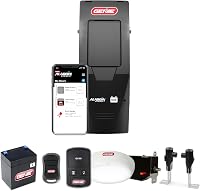
Genie 1055 Garage Door Opener Review: Worth It? (November 2026)
The Genie 1055 is worth keeping when its belt is in good shape, because the replacement parts that fit it are easy to source. The belt is the first thing to replace when the opener gets noisy or the door stops lifting smoothly.
On this page (7 sections)
The Genie 1055 is worth keeping when its belt is in good shape, because the replacement parts that fit it are easy to source. The belt is the first thing to replace when the opener gets noisy or the door stops lifting smoothly.
This review covers what the 1055 needs in daily use, which parts fit it and when a newer opener makes more sense. If you are weighing a different model, our roundup of the Genie garage door opener line puts the 1055 in context.
The Genie 1055 at a glance
The 1055 is a belt-drive opener for a standard 7 ft door, and its long-term health comes down to three parts: the drive belt, the remote and the wall console. Buyers searching Genie 1055 garage door opener reviews usually want to know whether those parts still fit, and they do.
Luriseminger Upgraded Drive Belt 39354R. S: Best for restoring a noisy 1055

- 216.7 in belt for 7 ft doors
- 39354R.S replacement fit
- 20 grooves per 6 in for quiet running
The direct-fit belt for a Genie 1055 with a belt rail. It brings back quiet, smooth travel on a 7 ft door.
Pros
- Matches the 39354R.S part number for 1055 and related Genie models
- Grooved surface is built to cut belt noise
- Steel belt clips in ASTM1045
Cons
- Only fits 7 ft doors, so a taller opening needs another belt
- Install means taking the old belt off and threading a new one
The belt is the part that wears first. A 216.7 in belt with 20 grooves per 6 inches is what the 1055 runs on, and replacing a stretched belt is the single biggest improvement you can make to a tired unit.
The replacement belt carries the 39354R.S part number and is built from polyurethane with steel belt clips, so it matches the rail and the trolley the opener already uses.
Who the 1055 still suits
Keep the 1055 if your door is a standard 7 ft residential door on a belt rail and the motor still runs. It suits a garage where noise matters, since belt drive is the quiet option for rooms above or beside the garage.
The 20 grooves per 6 inches on the replacement belt are there to keep that quiet character intact.
Skip it if the motor itself has failed or the rail is bent. At that point the cost of a belt, a remote and a console adds up close to a modern opener with a battery backup.
The parts are worth buying only when the unit they attach to is sound.
A 1055 also suits an owner who already has a Genie remote or keypad and wants to keep using it. The wall console and the G3T-R remote work on Genie openers of the right series and vintage, so existing accessories do not become waste.
The parts that matter in daily use
Three parts decide whether a 1055 feels smooth or annoying: the belt, the remote and the wall control. The belt sets the noise level and the door travel.
The remote sets convenience. The console sets security when you leave.
The 39354R.S belt is made from PU with new structural steel belt clips. That matters because the clips are what grip the rail, and worn clips cause the jerking that owners mistake for a motor fault.
The clips are listed as ASTM1045 steel, which resists corrosion in a damp garage.
The Genie G3T-R uses Intellicode rolling code technology that changes the access code on each press, so the code cannot be replayed from a distance. It also uses Auto-Seek dual frequency, which picks either 315 or 390 MHz to dodge interference from nearby devices.
For the console, the Series II wall control adds a back light and a slide lock. The slide lock is the feature most people miss once they have it, because it cuts remotes and keypads out while the house is empty.
The light button lets you switch the opener's lights on without moving the door.
What fits a Genie 1055 and what does not
The 1055 sits in the 39354R.S belt family, so fit starts with the part number rather than the model badge. The belt is built for Genie belt-rail openers whose model numbers start with 1055, 1155, 2055, 3053, 3055, 3155, 7055, 7155 or 7155L.
The opener must have a belt rail, so a screw-drive unit is not a match.
It also fits several named lines that share the same rail, including SilentMax Connect, StealthDrive 750, SilentMax 750, SilentMax 550, QuietLift 550 and StealthLift 500. That shared fit is why the belt is easy to find years after the opener was sold.
The same 216.7 in belt serves all of them, so the part stays in production.
The belt length is 216.7 inches and it is cut for a 7 ft high door. A taller opening needs a different belt, so measure your door height before ordering.
The size is listed as 39354R.S for a 7FT door, and the belt dimensions are 216.7 x 0.2 x 0.03 inches.
For the remote, the fit is by production year and technology. The G3T-R runs Genie openers made from 1997 to the present and up to two openers from 1995 to 1997 using the top two buttons.
It will not work on dipswitch openers. The three buttons let one remote cover up to three Genie openers, which is handy in a garage with more than one door.
For the console, fit is by series. The Series II console works with all Genie Series II openers made since 1995.
It will not work with Series III consoles or with any wall console that has a black button. The replacement models it covers include BWC2, GPWC, GWC-2 and GPWC-2WLB.
How to set up the belt, remote and console
Start with the belt, because a door that does not travel smoothly makes every other check harder. Take the old belt off the rail and thread the new 39354R.S belt through the same path.
The install step is the same one the old belt came off in, so there is no special tool or adapter to buy.
The belt comes with structural steel clips in ASTM1045. Seat the clips on the trolley the way the old ones sat, then tension the belt so it runs without slack.
A belt that is too loose slips; one that is too tight strains the motor.
Next, program the remote. The G3T-R has easy-to-follow instructions, and the pairing step depends on the opener's learn button.
Press the learn button, then the remote button, and wait for the opener to confirm. The kit includes the remote, a visor clip and a battery, so the remote is usable as soon as it is paired.
Then wire the console. The Series II wall console needs two mounting screws and two wires that attach to the back of the console.
Kill the power at the breaker first, then mount the console at a comfortable height. The screws and instructions come in the box.
The console has a back light so you can find it in the dark. That light is a small thing that makes a night-time entry much easier.
The slide lock on the console is separate from the door's own safety reverse, so it does not affect the safety beam.
If you are adding a second door or replacing a worn opener in a two-bay garage, the garage door opener for 2 car garage guide covers how to plan the pair.
Care that keeps a 1055 quiet
A 1055 stays quiet when the belt tension and the door hardware are both right. Most noise complaints trace back to one of those two, not to the motor.
Check the belt every few months. Run the door by hand with the opener released and listen for a rumble; a belt that has stretched or frayed will show as slack or a fuzzy edge.
The 20 grooves per 6 inches are what keep the belt seated on the rail, so a worn groove is a sign to replace.
Clean the rail and wipe the belt with a dry cloth. Grit on the grooves causes the vibration that people hear in the room above the garage.
Lubricate the door's rollers, hinges and springs rather than the belt itself. The door hardware is where friction builds, and a dry hinge can sound like a failing opener.
The belt's PU surface does not need oil.
Clear the photo-eye lenses and test the safety reverse. A belt that runs well still cannot make up for a misaligned safety sensor.
Keep the remote battery fresh. The G3T-R uses a CR123A battery, and a weak battery is the usual reason a remote stops responding before the opener does.
Re-pair the remote only after you have tried a new battery.
Use the Sure-Lock slide on the console when you travel. It locks out the remotes and keypads so the door cannot be opened from outside, and it is the simplest security step on the whole unit.
The trade-offs before you commit to a 1055
The 1055's main trade-off is age, not design. The belt-drive layout is quiet and reliable, but a unit this old may lack features that newer openers include.
The belt itself only fits 7 ft doors. If your door is 8 ft or the rail has been changed, the 39354R.S belt is not the right part.
The part number is tied to the belt rail, so a screw-drive opener needs a different replacement.
The G3T-R remote only runs Genie openers. In a house with a Chamberlain opener on the other bay, you'll carry two remotes.
It also will not operate dipswitch-era openers, so an early unit needs a different remote.
The Series II console needs a wired run. It also won't replace a Series III console or one with a black button, so the model you are swapping matters.
Check the old console before you order the new one.
On the positive side, the parts are inexpensive and widely available. Restoring a 1055 with a new belt and a fresh remote usually costs far less than a new opener.
The belt's PU and steel build is meant to hold up over the long term, which is what makes the repair worth doing once.
If you are comparing brands before you decide, our Chamberlain garage door opener roundup shows what the other major brand offers at similar price tiers.
The G3T-R remote as an alternative
The G3T-R is the part to buy when the door moves fine but the remotes have stopped working. Its Auto-Seek dual frequency picks 315 or 390 MHz to cut interference from nearby devices.
The maximum range is listed at 500 feet, so the signal reaches the opener from the driveway.
It runs up to three Genie openers and works on models from 1997 on. The top two buttons handle 1995 to 1997 units.
It does not work on dipswitch openers, so check your opener's vintage first. It can also train HomeLink and Car2U built-in car systems, so you can keep the visor clip for a second car.
The Series II wall console as an alternative
The Series II console suits a 1055 when the wall button is missing or worn. Its slide lock is the feature that makes it worth the upgrade over a plain button.
The console measures 4 x 0.75 x 2 inches and weighs 2.4 ounces, so it sits flush against the wall.
Install is two screws and two wires, and the light button works the opener's lights without moving the door. It fits all Genie Series II openers made since 1995, and it does not fit Series III consoles or black-button consoles.
The warranty is limited to one year.
If you are still deciding between Genie models, the Genie 2128 garage door opener reviews cover a newer unit that may suit a replacement plan better than another repair.
Verdict: keep the 1055 or replace it?
Keep the 1055 when the motor runs and the door is a standard 7 ft belt-rail setup. The Luriseminger 39354R.S belt is the best pick for most 1055 owners, because it restores quiet travel at the lowest cost.
The 216.7 in length, the 20 grooves per 6 inches and the ASTM1045 steel clips all line up with what the rail expects.
Add the G3T-R remote if your remotes are the weak point. It is the best pick for a lost or failing remote, since it uses the genuine Intellicode code and works on three doors.
Add the Series II wall console if you want a light button and a slide lock. It is the best pick for a security upgrade on a Series II opener.
Replace the whole unit if the motor has failed, the rail is bent or you want a battery backup. At that point a new opener with modern safety features makes more sense than chasing parts for an older one.
The belt, remote and console are all sold as replacement parts, but none of them fix a dead motor.
The honest summary from Genie 1055 garage door opener reviews is that this model is a repair-friendly opener. Its belt, remote and console are all still available, so the decision comes down to whether the motor and rail are sound.
If they are, the belt is the first buy.
Frequently asked questions
What belt fits a Genie 1055 garage door opener?
Use a 39354R.S drive belt for a 7 ft high door. That part number is the replacement belt for Genie belt-rail openers whose model numbers start with 1055.
The belt is 216.7 in long and runs on a 7 ft rail.
Does the G3T-R remote work with a 1055 opener?
The G3T-R works on Genie openers made from 1997 to the present, and on many 1995 to 1997 models with only two doors. It relies on Intellicode rolling codes.
It will not work on dipswitch openers.
Is the Series II wall console compatible with a Genie 1055?
The Series II wall console fits all Genie Series II openers made since 1995. It does not work with Series III consoles or with wall consoles that have a black button.
Check the console you are replacing before you order.
How do I know my 1055 needs a new belt instead of a new opener?
If the motor runs but the door stalls, jerks or moves with a loud rumble, the belt is the usual suspect. A belt that has stretched or frayed loses its grip on the rail.
Replacing it is far cheaper than a whole new opener.